

Recent Posts
- Company Setup in Canada for Non-Residents: A Complete Guide
- Doing Business in Canada: A South African Executive’s Guide
- How to Start a Business in Canada: A Complete Guide
- Business Banking in Canada for South African Company Owners
- Business Services in Canada: A Complete Guide for Entrepreneurs
- Opening a Corporation in Canada as a South African Citizen
Remote Supplier Verification: How Canadian Businesses Can Vet Indian Manufacturers
For Canadian businesses sourcing products from India, finding a manufacturer is only the beginning. The more important question is whether that manufacturer can consistently deliver the required quality, specifications, production capacity, and timelines.
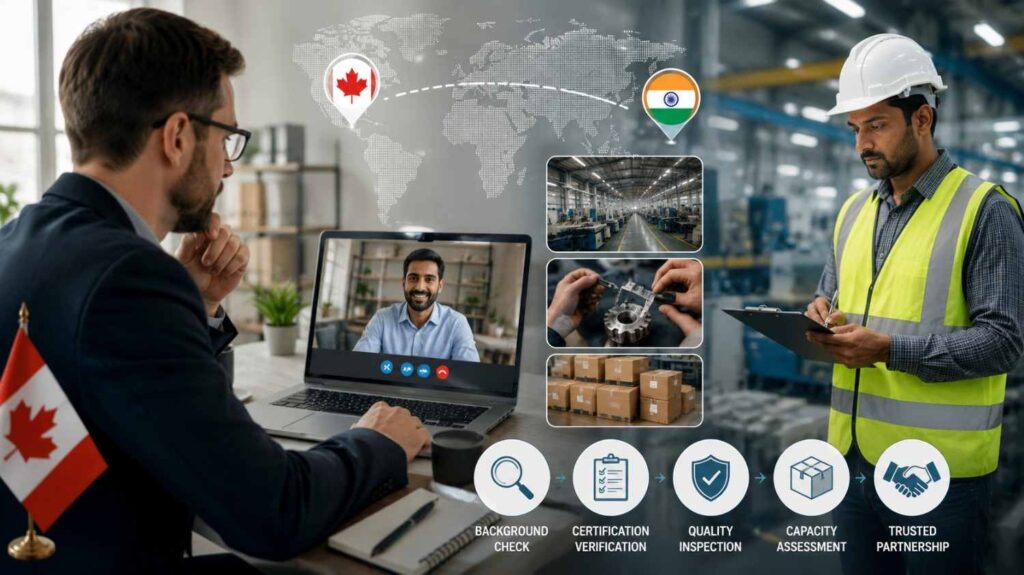
When visiting a factory in person is not practical, remote supplier verification becomes an important part of the sourcing process. Canadian businesses can use digital communication, documentation, product samples, video calls, production evidence, and third-party quality checks to evaluate Indian manufacturers before committing to a commercial relationship.
A structured remote verification process can help Canadian importers make more informed sourcing decisions while reducing avoidable supply-chain problems.
Why Remote Supplier Verification Matters
India has a diverse manufacturing ecosystem serving industries such as textiles, apparel, home products, handicrafts, packaging, leather goods, engineering products, and other commercial categories. Different manufacturing clusters also specialize in different products, making supplier research an important first step.
However, a supplier’s website or quotation does not provide enough information to determine whether the company is the right manufacturing partner.
Canadian buyers should look beyond price and evaluate production capability, communication, product quality, capacity, export experience, packaging, lead times, and the manufacturer’s ability to meet clearly defined specifications.
Start With a Detailed Supplier Profile
Before evaluating an Indian manufacturer, Canadian businesses should create a clear supplier profile describing what they need.
The profile can include the product category, materials, dimensions, colours, finishes, packaging requirements, expected production schedule, quality expectations, estimated purchasing requirements, and branding specifications.
A detailed product specification gives manufacturers a consistent basis for quotation and discussion. It also makes it easier for the Canadian buyer to compare multiple suppliers without relying only on price.
Complete Consulting Canada’s existing sourcing resources emphasize product specifications, supplier capabilities, quality expectations, production capacity, communication, and delivery schedules as important considerations when evaluating Indian suppliers.
Verify the Manufacturer’s Business Information
Remote verification should begin with basic company information.
Canadian buyers can request the manufacturer’s complete business name, factory location, contact information, product categories, years of manufacturing experience, production capabilities, and relevant business documentation.
The information should be reviewed for consistency across the supplier’s website, email communications, quotations, invoices, product catalogues, and other available business materials.
A professional manufacturer should be able to clearly explain what it produces, where production takes place, what capabilities it maintains, and which types of customers it typically serves.
Request a Live Video Factory Tour
A live video call can provide valuable insight when an in-person factory visit is not possible.
Rather than relying only on photographs supplied by a manufacturer, Canadian businesses can request a real-time video tour of relevant production areas. The discussion can cover machinery, raw materials, production lines, storage areas, packaging processes, quality-control activities, and finished products.
The objective is not simply to see a factory. It is to determine whether the manufacturer’s actual capabilities appear consistent with the products and specifications being discussed.
Businesses should also ask practical questions during the call. How is production scheduled? How are quality issues identified? What happens when a product does not meet specifications? How is finished inventory handled?
The manufacturer’s willingness and ability to answer these questions can provide useful insight into its operational maturity.
Always Request Product Samples
Samples are one of the most practical tools for remote supplier evaluation.
A Canadian buyer should request samples that closely represent the product intended for commercial production. The sample can then be evaluated for materials, construction, dimensions, finishing, packaging, colour, functionality, and overall quality.
For customized products, the approved sample should become a clear reference for future production.
It is important to remember that a good sample does not automatically guarantee consistent production quality. Buyers should therefore establish a process for monitoring quality during manufacturing as the supplier relationship develops.
Evaluate Production Capacity
A manufacturer may produce an excellent sample but still struggle with recurring commercial requirements.
Canadian businesses should ask about production capacity, available machinery, workforce, typical lead times, peak-season capacity, and the ability to handle repeat production.
The objective is to determine whether the manufacturer can support the Canadian business as demand increases.
A supplier that cannot maintain consistent production schedules may create inventory shortages, delayed launches, or customer-service problems even when the product itself meets expectations.
Assess Communication Before Placing an Order
Communication is one of the most important parts of international supplier management.
Canadian businesses should evaluate how quickly and clearly a manufacturer responds to questions. Important product specifications, timelines, packaging instructions, pricing details, and quality expectations should be documented rather than relying only on informal conversations.
If communication becomes difficult during the initial evaluation stage, managing more complex production requirements later may become challenging.
A dependable supplier should be able to communicate clearly about production progress, potential delays, specification questions, and quality concerns.
Consider Independent Quality Verification
Remote verification can be strengthened through independent quality checks.
Depending on the product and sourcing arrangement, a Canadian business may arrange inspection activities before shipment or at selected stages of production. This can provide an additional layer of information beyond the supplier’s own quality-control process.
Quality expectations should be established before production begins. Clear specifications, approved samples, inspection criteria, and documented requirements can make quality evaluation more objective.
Complete Consulting Canada’s sourcing resources also emphasize building quality control into the sourcing process rather than treating it as an afterthought.
Compare Suppliers Beyond Price
Price is important, but it should not be the only factor in supplier selection.
A lower quotation may become less attractive if the manufacturer has inconsistent quality, longer lead times, poor communication, limited capacity, or higher transportation and handling costs.
Canadian businesses should consider the overall sourcing value, including product quality, production reliability, communication, packaging, delivery schedules, supplier responsiveness, and total landed cost.
Comparing suppliers using the same evaluation criteria can make the final decision more objective.
Build a Supplier Verification System
Remote supplier verification should not end once the first order is completed.
Canadian businesses can establish ongoing supplier reviews based on product quality, delivery performance, communication, responsiveness, production consistency, and ability to meet agreed requirements.
Regular performance reviews can help identify problems early and determine whether a supplier remains suitable as the business grows.
A strong India-to-Canada sourcing strategy connects supplier discovery with product specifications, quality control, logistics, landed-cost planning, and inventory management.
Complete Consulting Canada for India-to-Canada Sourcing
Complete Consulting Canada supports entrepreneurs and businesses developing and expanding their Canadian operations, with resources and services covering areas such as business setup, market entry, eCommerce, logistics, supply-chain activities, and international sourcing.
For Canadian businesses exploring Indian manufacturers, supplier verification is an important part of developing a reliable sourcing strategy. Complete Consulting Canada can support the broader Canadian business and operational planning surrounding an India-to-Canada sourcing model.
By combining supplier research, remote verification, product sampling, production evaluation, quality planning, communication, and logistics coordination, Canadian businesses can make more informed sourcing decisions and build stronger long-term supplier relationships.
Frequently Asked Questions
Canadian businesses can review company information, request documentation, conduct live video factory tours, obtain product samples, evaluate production capabilities, assess communication, and use independent quality checks where appropriate.
Canadian buyers should evaluate product quality, manufacturing capabilities, production capacity, communication, lead times, export experience, packaging, pricing, and the manufacturer’s ability to meet agreed product specifications.
A sample is important but should not be the only verification method. Businesses should also evaluate manufacturing capabilities, production processes, quality procedures, communication, capacity, and ongoing performance.
Yes. A live video factory tour can allow Canadian buyers to view production areas, machinery, materials, storage, packaging, and other relevant operations without travelling to India.
Quality control is essential for maintaining consistent products. Canadian buyers should establish clear specifications, approve samples, define quality expectations, and consider appropriate inspections during production or before shipment.
No. Price should be considered alongside quality, production reliability, communication, capacity, lead times, packaging, logistics, and total landed cost.
Complete Consulting Canada provides Canadian-focused business consulting and resources covering areas such as market entry, business setup, logistics, supply-chain planning, eCommerce, and international sourcing. Its resources also address supplier evaluation and India-to-Canada product sourcing.